Limited Fork graphic

Wednesday, February 27, 2013

A Call for More Virtuous Video Games

I am not a fan of video games.

Mindlessly falling away into a realm of flashing lights and sounds of illusion is often a means to mental decay. Modern video games have become more concrete and closely parallel to society. People blast away at the avatars of others with artificial guns, peppering virtual bodies with imaginary bullets. The sights and sounds are brought to life before our eyes and the lack of abstraction takes us to a place we can perceive, without much thought, as reality. While this is often the basis for arguments against violent video games, I am not trying to debate against the content of these games, simply the premise and existence for them. At their core, they lack ingenuity. They are largely based off of war, sports, or racing, and while we typically may not  have access to the full extent of these activities in real life, the fact that these games are simply reflections of this reality does not aide in the mental development of players.

Video games need to be more intuitive, leaving more to the imagination and less to graphics. While technology becomes increasingly easier to use and manipulate, a higher creativity is required for furthering greater development. With fresh and innovative ideas, we can form technology as not only as a wondrous tool to eliminate grueling and grinding work (such as mindless data entry, etc) but a refreshing toy that teaches us how to think and learn.

We need technology to better our minds, not help them. VectorPark.com is a beautiful example of what improved technology can create. It breaks the mold for what video games have popularly become. It defines something new and strange, something that makes us think and learn, like children, developing a greater plasticity in which we can continue to learn and figure out the unknown. There is a small niche of these games in existence and they revolve around a philosophy of thought and intuition, rather than a dexterity of control. It challenges the mind by pushing the player into a flow state. If we, as a society, can learn to embrace the unique, the strange, and the challenging, we could develop a whole new line of video games and draw in a more intellectual audience that benefits society, rather than detract from it.


So start by playing Feed The Head, both for your intellectual and visual enjoyment. This game, like any form of art, holds the potential to inspire you.

Tuesday, February 26, 2013

Religious or crazy?

Religion is not viewed as crazy; praying to someone who is not there, putting all your faith and belief in a figure who you have never met or seen, performing acts that this "God" tells you to do for the good of mankind, etc. But believing in ghosts and spirits and extra terrestrials is viewed as crazy. Or if you are a schizophrenic and believe that you are seeing a person right in front of you speaking to you, even if that person is "god" perhaps, you may be classified as "insane" rather than religious... How on earth has our society become so disconnected from our spiritual side and so afraid of alternate beliefs that the answer is either religious or crazy?

We watched A Beautiful Mind in class the other day and got into this discussion... What is classified as crazy? Are artists crazy? Do we have to be crazy in order to create our most compelling art? What about the fact that I personally have seen a UFO? Or what about the fact that my sister is a medium (can see spirits and ghosts) and I have had a personal encounter with a ghost where they moved right through my body and apologized for it? What about aliens? Do they exist?... Do you think I'm crazy for stating/believing in these things?...

How can we be so naïve to believe that with the size of this universe and the history of this earth that we are the only beings that can exist or that there can be only one set of logical belief systems?

I continued this discussion with my roommate and good friend, Ian, last night. We got into a discussion of people in general, and how most of us refuse to acknowledge things in ourselves that we don't want to deal with. For example, if a boyfriend cheats on his girlfriend, they will then not want to talk about it and therefore pretend it didn't happen. But it did happen, and them not acknowledging it and dealing with it is avoiding the pain and of their actions and a denial of truth within themselves. I believe this applies to belief systems as well. Perhaps so many people cling onto religion because they are not ready to deal with a possibly painful truth that they are alone. Or perhaps so many people are adamant about others' beliefs in ghosts or extra terrestrials because they are afraid that they might actually exist.

I am in no way against religion. I actually do have some kind of faith in something, though I don't know what exactly. But I think this is something that needs to be questioned and discussed and thought about, if not to find some answers than to simply create some honest awareness.

Monday, February 25, 2013

Alone in Union Station


Sitting in Chicago’s Union Station is interesting.  I am here alone, but not really alone, there are a lot of people who rush around me.  Yet, I feel alone.  I feel kind of uneasy.  I feel that I just want to be back in Ann Arbor, in my familiar Ann Arbor city, with my familiar buildings and streets and people and knick-knacks.  Even thought I want to be somewhere I am not, I also regret those feelings.  It makes me feel weak and I hate feeling weak.  It makes me think, and sometimes I hate when I think. I hate when I think mainly because it leads to more uneasiness.  Not just uneasiness from the unfamiliar and big city environment, but also uneasiness within myself. This happens because I am not able to talk to anyone else; I just have myself to listen to.  Memories and worries, ambitions, and regrets seem to always leak out of my soul and into my brain when I am alone.  I wonder how many others around me have similar feelings? Looking around me, there are a lot of people who are also “alone.”  But they have families, they have worries, they have goals, they want to be somewhere other then here.  If all the people disappeared and all that was left was the feelings of people, I believe it would look like swirling ghosts; I believe these ghosts would find connections amongst each other and make friends.  I believe the room would no longer be lonely; instead it would be friendly and exciting.  Isn’t it amazing how flesh and bones so easily tear us apart from making friends? That hair and fingernails stop us from saying hello? That cloth and rubber acts as force fields from sitting near each other? If the flesh and bones melted away, if the hair and fingernails fell off, if the cloth and rubber dissolved, what would the world be like? What problems would we have, if any? If we could only see emotions and nothing else, would the word be happier? Safer? Hmmmmmm it is interesting to think about, and these thoughts overrule my uneasiness, which is nice for a minute.  I decide to give into my rumbling tummy and buy food, pay the cashier, and pick a spot three seats away from the nearest person.  Funny how thoughts and actions are completely unrelated in real life. 

....These thoughts continue to inspire my end of the year project....the first being a series of ceramic pieces and the second a series of white t-shirts.... I want to use each to explore how different types of media can be used for expression, where some pieces represent how others perceive me, and 

Sound as an Object

Lately in my film class, we've discussed how sound is treated like an object by filmmakers. Viewers often anticipate that a sound is dictated by, or connected to, an image; it is jarring or unexpected for a sound to seem inorganic. Yet the most creative teams match sound and image in ways that are both unexpected and narratively important. Playing with this idea for a while gave me a stronger direction for my project to teach myself how to animate. I had several ideas for videos, but really wanted to play with the relationship between image and sound. So, I decided to pick what I think to be an abstract song, and come up with a narrative guided by the sounds.

Here is what I picked:

This song is a good representation of how music can exist without a traditional verse, bridge, chorus format. I particularly like it because of this absence of words, and I will maintain this in my project. Image and sound will be used to create a narrative--a short narrative--that I hope will be as effective in telling a story as a book. Film and music are different formats than something written (which we've agreed on in class is the best definition), but I do not think it eliminates them from being effective story-telling mechanisms. 

My new Blog idea

Check out of new blog idea- quotes!!! - CHECK IT OUT! :) See you in class tomorrow!

Sunday, February 24, 2013

A Vlogumentary

Considering we spend so much time in front of screens, we might as well turn all of reality into screen life.
I have an idea for a long-term project. An ongoing documentary/vlog about the mundane aspects of reality that the Internet does not fully capture yet. Toothbrushing, showering, making the bed, walking, pressing elevator buttons, opening doors, tying shoes, preparing food, eating food, releasing food, talking, plugging in laptop chargers, breathing, zippering a backpack, folding sheets, pouring laundry detergent, drinking water, driving cars, filling cars with gasoline, opening cans, shaving, holding hands, buying groceries, mopping a floor, and smiling.
Each piece of this vlogumentary will highlight a different aspect of everyday living. There will be an entire segment focused on covering all aspects of trimming toe nails, for example, or swiping a Visa card at stores. Every time I clip a chunk of nail or fumble for my wallet, it will be recorded. The duration of each activity will vary on the topic. Toothbrushing may require 3-4 weeks of intensive filming while turning keys in locks may only require 48 hours.
I hope this project will help capture the fullness of what it means to be a modern day human. A 21st Century Homo Sapiens. Perhaps it will say something about the Do Easy method of living or the pointless amount of time we waste on simply surviving as opposed to prospering.
I think I will begin this project by filming myself eating. There is a lot to go off with this topic. Does the time of day I eat affect my appetite/mood? Does the food I consume affect my mental state, alertness, and/or emotions/personality? Is there a correlation between the type of food I consume and the time of day in which I consume said food?
I'm sure there is a proper scientific method for answering these questions and lots of thorough experiments I could apply to test and measure this, but I'll let more intelligent people do that job. I'll just start by recording.
The little red dot is blinking.

Silicon Shuttles to a Synthetic State

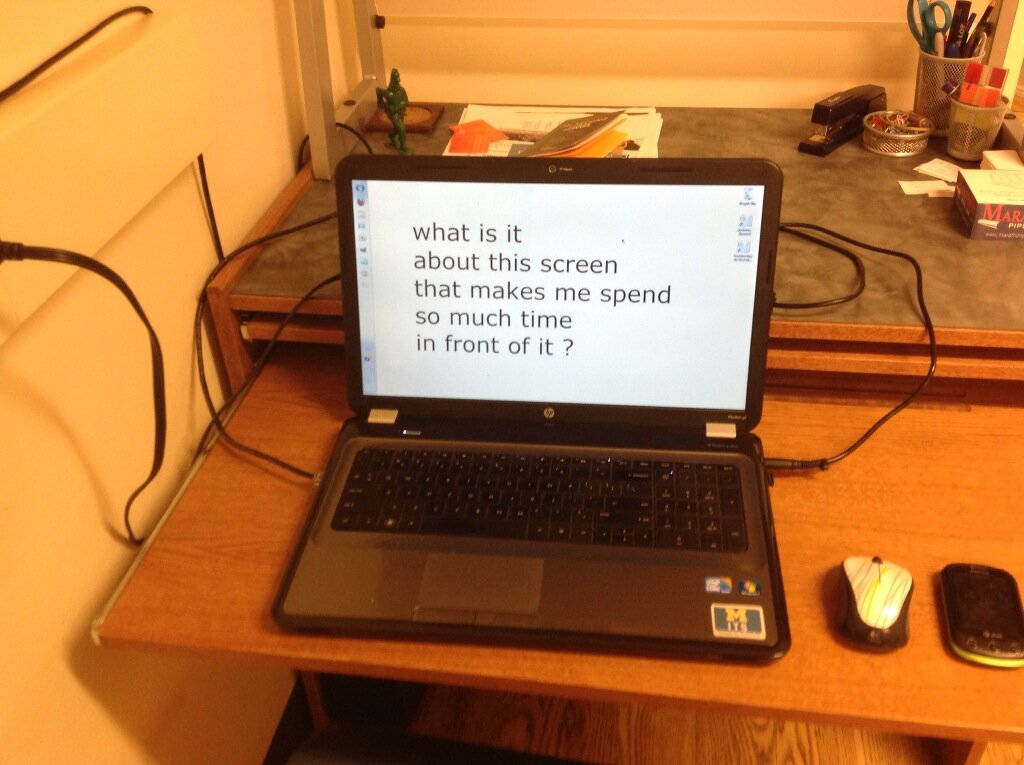
On average, we spend <insert shockingly high but hopefully accurate statistic here> hours in front of a screen every day. These screens are windows to whatever we wish to see. The internet offers us places we’ve never been and people we’ve never met IRL. Our lives exist in front of them, our eyes scanning spreadsheets and two-dimensional newsfeeds when they were designed to perceive depth and location of prey we used to hunt. We have no reason to search after running animals when we can purchase preservative-pumped meat through online retailers. Computers take away our need to move beyond the glowing pixels in front of us.

With several hours spent before screens each day, one begins to wonder the aesthetic appeal of such devices. Is it the great graphics that draw us in? New Apple products are perpetually improving upon display and interface design. Is it the simple appeal of the Internet and the indirect connections we can make with other humans? Constant improvements on social media sites and web browsers are adapting to make these experiences increasingly easier to access, speedier, and more enjoyable. Whatever the case may be, we are spending exponentially more time before screens as “better” technology continues to develop. In this sense, a significant portion of our minds and presence exists within this virtual realm. We take up residence in our homepages and online media sites, but when we exit out of our browsers, we are faced with an image that overtakes our field of vision—our desktop.


Most often, these pieces of art are beautiful depictions of the real world, whether it is a panoramic view of mountains or oceans or a photo of family or friends. These pictures can be cycled and rotate, becoming abstract shapes and designs, but in whatever case, they are what we perceive as visually pleasant. If these images are constructs of actuality, as art is most often based off inspiration found in the real world, why is it that they make such a dominant presence in our virtual existence? Perhaps we are setting up a home in the screen, a place to find peace or silence when the world is loud or find action and life when reality goes dim? If computers are the places for our minds to explore and wander, the world is left to be a simple provider. Rather than be enjoyed or explored as a primary passion, it is a place we are simply stuck in and thus escape to the virtual realm. Beautiful desktop images serve as enjoyable views when glued to the screen. These pieces of art can be seen as indirectly evil, as they are offering a Land of Lotus leaves to our visual senses, enticing them to spend more time before the screen. For this reason, I have set my desktop to the most atrocious scene I could spawn:
 

Rather than waste away my years before a screen, lulled into satisfaction by misleading visual art mimicking the true beauty of the real world, I hope to spend less time in front of the screen and more time in reality. Despite the many great tools it can provide, the computer is a double-edged sword. We ask it questions and it answers them. If we ask it why we should spend more time in reality, it will give us an answer, perhaps even a good one, but it will lure us back to our virtual desktops.

Google, why do I ask you my life questions? And how does Yahoo always have the answer?

Maybe that’s why I spend so much time in front of this screen?